


.png)
How Four Column Press Adapts to Manufacturing Changes
A production line that ran the same part for months last year now switches between three or four variations in a single week. Equipment bought for one specific job sits idle half the time because the next order needs something slightly different. That gap between what a machine was built for and what a factory floor actually needs day to day is where the four column press keeps finding relevance.
Why Manufacturing Requirements Keep Shifting
Modern production rarely stays fixed on one product for long stretches. A factory making brackets for one client might get an order next month for a slightly different bracket, or a smaller batch than usual, or a version with a different finish.
| Manufacturing Trend | Effect on Equipment Needs |
|---|---|
| Product variation | Machines need to handle more than one job |
| Faster order turnaround | Setup time between jobs matters more |
| Custom orders | Equipment needs room for adjustment |
| Workflow changes | Machines need to fit into different line layouts |
A press that only works well for a single fixed process becomes a bottleneck the moment a factory needs to pivot.
What a Four Column Press Actually Is
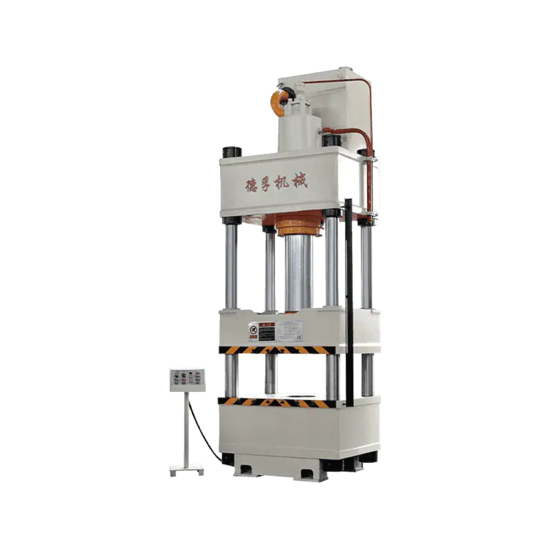
The name describes the structure directly — a frame held up by four vertical columns, with an open working area in between. That openness is the point. Instead of a closed frame that limits access to one side, the four-column setup lets operators approach the work area from multiple directions.
Common uses on a shop floor include:
- Forming metal or composite parts into a set shape
- Assembling components that need pressure applied evenly
- Shaping materials before further processing
- Surface work like stamping or embossing
- General support tasks in a larger production sequence
Because the structure itself isn't tied to one specific process, the same press often ends up doing several different jobs across a week.
How the Open Frame Helps With Changeovers
Switching a production line from one job to another usually means repositioning materials, adjusting tooling, or changing how parts feed into the machine. A closed-frame press can make that awkward if access is limited to one side.
| Structural Feature | What It Does on the Floor |
|---|---|
| Open working area | Operators can load and adjust from more than one angle |
| Balanced frame | Keeps the press steady even under uneven loads |
| Flexible workspace | Different part sizes fit without major rework |
| Simple layout | Easier for new operators to learn quickly |
A maintenance technician switching tooling between morning and afternoon runs notices this directly — less time spent working around the frame, more time spent on the actual adjustment.
Why Flexibility Matters More Than It Used To
Customers ordering smaller batches or requesting custom variations has become routine rather than exceptional. A factory that can only run large, uniform batches efficiently starts losing those orders to competitors who can adjust faster.
Flexible equipment supports:
- Running different part variations without swapping the whole machine
- Shorter gaps between one job ending and the next starting
- Scheduling that doesn't depend on one piece of equipment doing only one thing
- Planning production around actual order volume instead of machine limitations
A four column press fits into this pattern because the same unit can often be reconfigured for a new job rather than replaced.
Where This Equipment Shows Up Across Industries
Different industries need surprisingly similar physical operations even when the end products look nothing alike.
| Industry | Typical Role |
|---|---|
| Automotive | Forming and assembling smaller components |
| Electronics | Supporting steps in product assembly |
| Household products | Shaping materials into set forms |
| Industrial equipment | Processing components for larger machinery |
| Consumer goods | General manufacturing support tasks |
A factory serving more than one of these sectors can sometimes use the same press across different production lines instead of buying separate machines for each.
Efficiency Beyond Just Speed
Running fast doesn't help much if materials are moving around inefficiently or operators are waiting on each other. Efficiency on a shop floor usually comes down to reducing wasted motion and keeping a predictable flow from one step to the next.
A four column press contributes to this by:
- Keeping the work area organized around a fixed, accessible frame
- Reducing the number of separate machines needed for related tasks
- Supporting a steady sequence from material intake to finished part
- Allowing quick adjustments without restructuring the whole line
None of this replaces good process planning, but the equipment layout either supports that planning or works against it.
Responding to Custom Orders
Customers asking for a slightly different finish, a modified shape, or a smaller run than usual puts pressure on equipment that wasn't built with adjustment in mind.
| Manufacturing Need | How the Press Helps |
|---|---|
| Product variation | Same frame supports different tooling setups |
| Smaller runs | Changeover doesn't require major downtime |
| Design tweaks | Adjustments happen within the existing setup |
| Mixed production | One machine covers multiple related tasks |
A shop taking on a one-off custom order alongside its regular production benefits directly from this kind of adaptability — it avoids setting aside a separate machine just for the exception.
Why Workspace Layout Affects Daily Operations
How equipment sits on the floor affects how materials move, how operators walk between stations, and how much time gets lost to awkward positioning.
The open structure of a four column press supports:
- Materials being staged close to the working area without obstruction
- Operators moving around the frame instead of working through a narrow gap
- A layout that fits into different floor plans without major reconfiguration
- Fewer interruptions caused by equipment blocking natural movement paths
A factory redesigning its floor plan often finds this type of equipment easier to reposition than machines built with fixed, single-direction access.
Fitting Alongside Automated Systems
Manufacturing floors increasingly mix automated and manual steps rather than committing fully to one or the other. A press that only works in a fully manual setup, or only in a fully automated one, limits how a factory can grow its process over time.
Modern lines tend to focus on:
- Keeping output consistent between manual and automated stages
- Coordinating handoffs between machines and operators
- Equipment that can be adjusted as automation gets added gradually
- Planning production steps around what's actually feasible on the floor, not just on paper
A four column press tends to fit into this kind of gradual transition because its open structure doesn't require a complete redesign to add automated feeding or handling later.
Why Reliability Matters for Equipment Bought Once
Industrial equipment isn't something factories replace casually. A press bought this year needs to still be useful in a few years, even if the products running through it change.
| Business Priority | What It Means Long-Term |
|---|---|
| Stable operation | Fewer unplanned stoppages during production |
| Flexible applications | The machine adapts as product lines shift |
| Consistent performance | Output quality doesn't drift over time |
| Practical maintenance | Repairs and upkeep don't require specialized outside support constantly |
A factory manager evaluating new equipment usually weighs this against upfront cost — a press that adapts to future needs avoids a second purchase down the line.
Sustainability as a Practical Factor, Not a Slogan
Manufacturers increasingly think about material waste and equipment lifespan as part of regular planning rather than a separate environmental initiative.
Considerations that come up in practice:
- Whether a machine's lifespan justifies its resource and material footprint
- How efficiently materials get used during forming or shaping
- Whether one flexible machine can replace several single-purpose ones
- How much waste gets generated during typical operation
A four column press supporting multiple applications reduces the need for separate specialized machines, which has a direct effect on overall material and resource use across a factory.
Where This Leaves Manufacturers Planning Ahead
Production needs will keep shifting as customers ask for more variation and faster turnaround. Equipment that only handles one narrow task tends to become a limitation rather than an asset once those demands change.
The four column press continues showing up on shop floors because its open, adaptable structure fits into that shifting reality without forcing a factory to redesign its whole workflow. For a business evaluating new equipment, the practical question worth asking a supplier is how the press handles changeovers between different job types — that answer tends to reveal more about long-term fit than a spec sheet alone.